HIPAA Compliant Email: Best Practices Guide (2026)
HIPAA email compliance requires four layers: governance, process, technical controls, and evidence. Learn how to protect PHI without breaking your workflow.

Email is your healthcare organization's most dangerous workflow tool. Not your EHR. Not your patient portal. Email.
Why? Because email is both a transport layer (information leaves your secure systems) and a storage system (people keep messages forever on laptops, phones, and in search indexes that live far beyond your control). One misaddressed message, one compromised mailbox, or one staff member who doesn't understand the rules can turn into a multi-million dollar problem overnight.
The numbers tell a brutal story. Breach reports increased 102% from 2018 to 2023, with over 167 million individuals affected in 2023 alone. Between 2024 and 2025, more than 180 healthcare organizations suffered email-related data breaches, and the average cost per breach hit $9.8 million.
Email isn't always the initial entry point, but it's consistently part of the damage path: phishing campaigns that steal credentials, inbox rules that silently auto-forward protected health information (PHI), and inboxes stuffed with attachments containing patient data.
Critical reality: HIPAA doesn't ban email. It requires that if email contains PHI or electronic protected health information (ePHI), you must protect confidentiality, integrity, and availability with reasonable and appropriate safeguards. And you must be able to prove it.
This isn't legal advice. You should talk to your compliance counsel. But this is the practical, audit-survivable playbook for healthcare organizations that want to keep using Gmail or Microsoft 365 without becoming the next "we accidentally emailed a spreadsheet to the wrong person" headline.
How HIPAA Email Compliance Works: The Four-Layer System
Most organizations fail at HIPAA-compliant email because they only think about technology. They turn on TLS encryption and call it done. That's not enough.
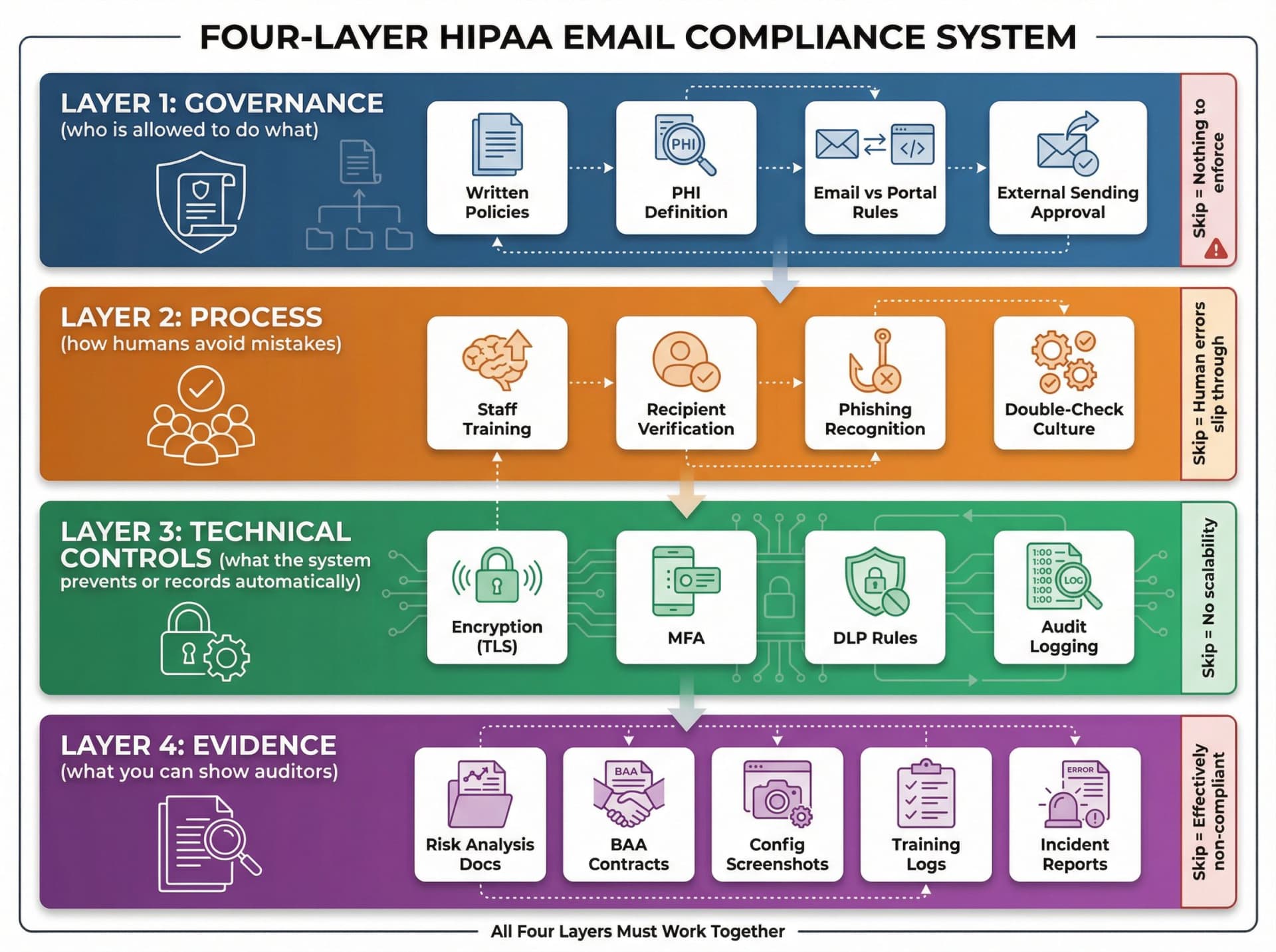
Think of HIPAA-compliant email as a system with four interdependent layers.
Layer 1: Governance covers who is allowed to do what. This means written policies defining what counts as PHI, when email is allowed versus when a secure portal is required, who can send ePHI externally, and what the approval process looks like. Without documented governance, you have nothing to enforce.
Layer 2: Process addresses the human element. It's about training staff on recipient verification, teaching them to recognize phishing, establishing a "double-check before send" culture, and creating workflows that make the safe path the easy path.
Layer 3: Technical controls are what the system prevents or records automatically. This is where encryption, multi-factor authentication (MFA), data loss prevention (DLP) rules, and audit logging live. These technical safeguards catch mistakes before they become breaches and create an electronic paper trail.
Layer 4: Evidence is what you can show auditors after something goes wrong. Your risk analysis documentation, vendor contracts with Business Associate Agreements (BAAs), configuration screenshots, training attendance logs, and incident response records all live here. If you can't prove it happened, it didn't happen in the eyes of an auditor.
| Layer | What Happens If You Skip It |
|---|---|
| Governance | No written policies = nothing to enforce during audits |
| Process | Technology can't fix human errors like wrong recipients |
| Technical | Manual compliance doesn't scale and creates gaps |
| Evidence | Can't prove compliance = you're effectively non-compliant |
Most organizations build a great Layer 3 (they turn on TLS encryption) and ignore everything else. Then they're shocked when a staff member emails the wrong person, or when they can't produce evidence of their security controls during an investigation. You need all four layers working together.
When Does Email Need to Be HIPAA Compliant?
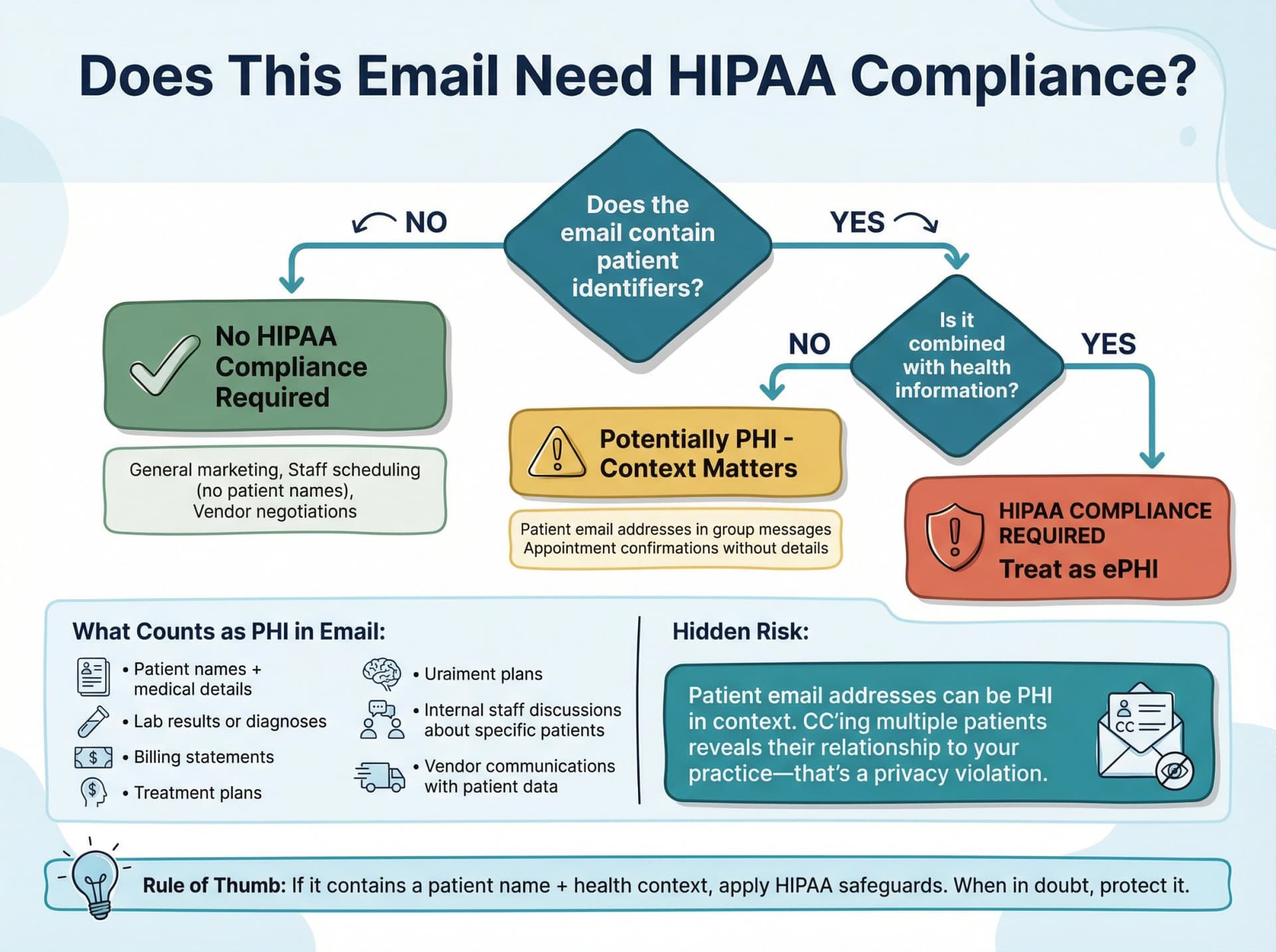
Not every email in a healthcare organization triggers HIPAA obligations. But you need to treat any email containing PHI as subject to HIPAA rules.
Under HIPAA, covered entities (health plans, healthcare providers, and clearinghouses) and their business associates must safeguard PHI in any form, including electronic communications like email. This means if an email includes patient identifiers combined with health information, it becomes ePHI and triggers compliance requirements.
PHI in email takes many forms. Patient names alongside medical details, diagnoses, or treatment info are the obvious cases. But appointment reminders that identify the patient and relate to their care also qualify, as do lab results, billing statements, and insurance claims. Internal staff discussions about specific patients count too, along with communications with third-party vendors (billing companies, labs, IT support) that include patient data. Even something as simple as a group email newsletter could be problematic if it references individual patients or reveals their relationship to your practice.
There's a less obvious risk: patient email addresses themselves can be PHI in context. If you CC multiple patients in one email, you've just revealed each recipient's identity to all the others. That's a privacy violation all by itself.
The rule of thumb is straightforward: if an email contains a patient's name alongside health-related information, treat it as PHI and secure it accordingly. When in doubt, apply HIPAA safeguards.
Why Business Associate Agreements Are Required
Before you send a single email with PHI, you need to understand Business Associate Agreements. There's no negotiating this one.
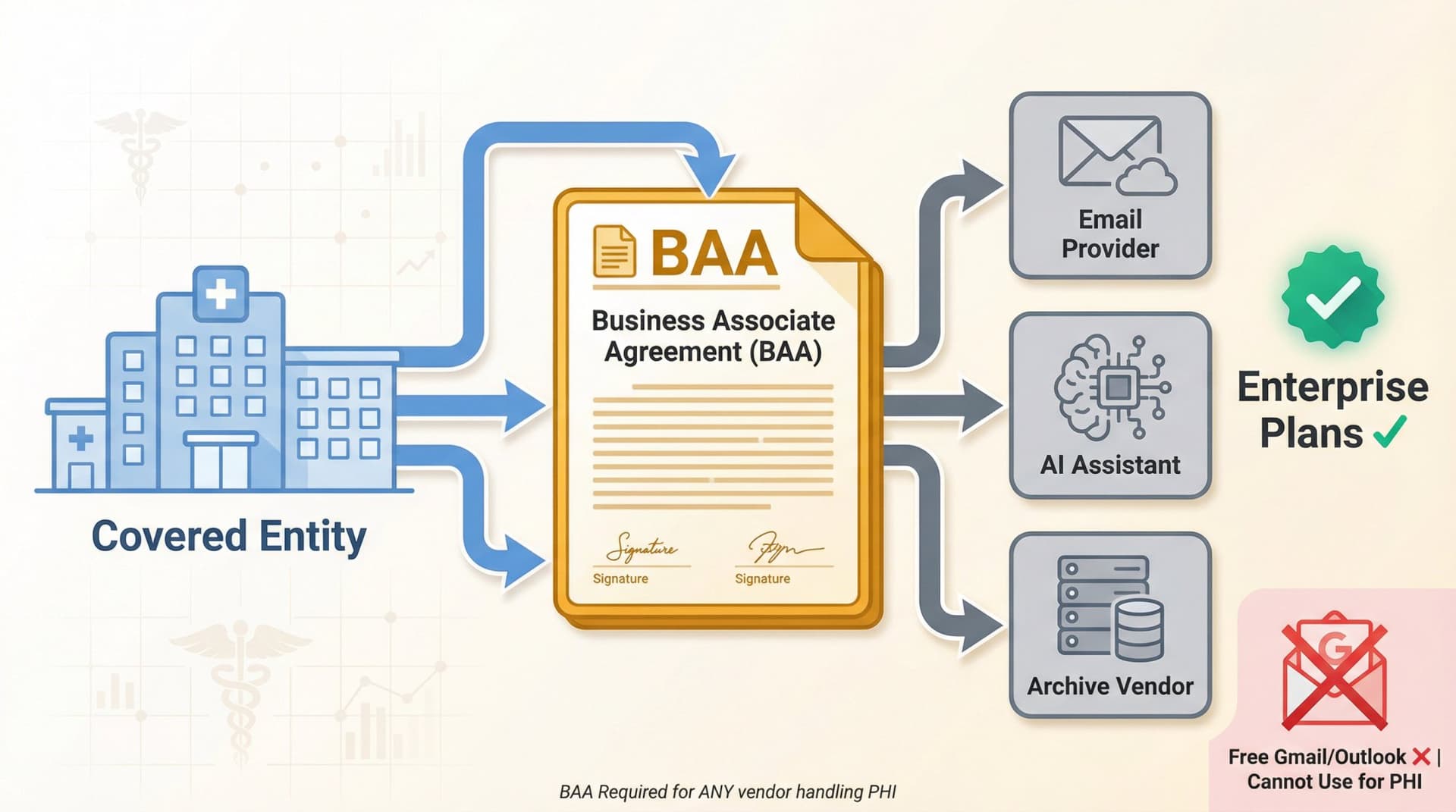
If a third party handles PHI on your behalf, they're usually a business associate, and HIPAA requires a BAA. The agreement must include specific elements: permitted uses and disclosures of PHI, requirements to implement safeguards, breach reporting obligations, and data return or destruction procedures upon contract termination.
The list of email vendors requiring a BAA is longer than most people realize. Google Workspace and Gmail (when used for HIPAA workloads), Microsoft 365 and Exchange Online, email encryption gateways, secure portal providers, archiving and e-discovery vendors, spam and phishing filtering vendors that process message content, and any AI email assistant that reads or drafts emails containing PHI all need BAAs in place.
The critical trap here is free consumer email accounts. They cannot be used for PHI, period. Google and Microsoft won't sign BAAs for free Gmail or Outlook accounts. You need their paid enterprise services (Google Workspace Enterprise, Microsoft 365 Business/Enterprise plans), and even then, the BAA is separate from the paid subscription.
Some organizations think, "But our ePHI is encrypted, so we don't need a BAA with the cloud provider." That's wrong. The Department of Health and Human Services (HHS) cloud computing guidance is clear: a cloud service provider that stores ePHI is not a "mere conduit" and is a business associate, even if the ePHI is encrypted and the provider doesn't have the decryption key. "But it's encrypted!" does not magically remove BAA obligations.
What HIPAA Requires for Email: Core Rules
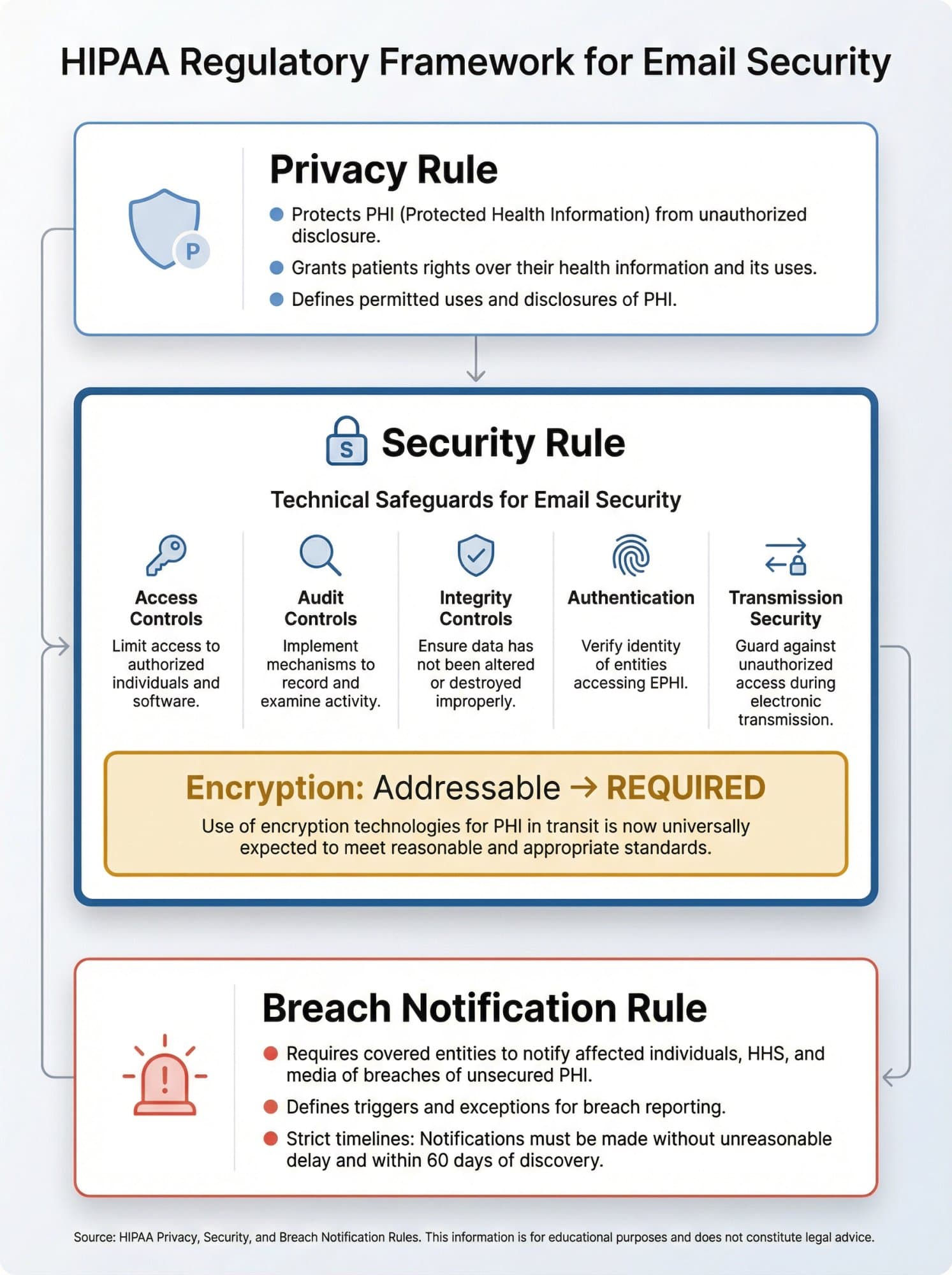
HIPAA's rules relevant to email fall across three major regulations: the Privacy Rule, the Security Rule, and the Breach Notification Rule.
The Security Rule establishes standards for protecting ePHI and includes technical safeguards like access controls, audit controls, integrity controls, authentication, and transmission security. These aren't optional checkboxes. They're requirements with real teeth.
Here's the compliance reality in 60 seconds.
First, email almost always becomes ePHI. Even "just an appointment reminder" can be PHI if it identifies the patient and relates to their care. If it has patient identifiers plus health context, treat it as PHI.
Second, HIPAA is risk-based. Risk analysis is explicitly called "foundational" by HHS's Office for Civil Rights (OCR). It must cover all ePHI you create, receive, maintain, or transmit, including email. You can't just implement controls randomly. You need to analyze your actual risks first.
Third, encryption is evolving from "addressable" to required. Under the current Security Rule, encryption is an "addressable" implementation specification, meaning you must implement it if reasonable and appropriate or document why you didn't and what you did instead. But OCR's proposed 2025 Security Rule update would make encryption (both at rest and in transit) and MFA explicitly required, with limited exceptions. Build as if encryption and MFA are mandatory, because that's where enforcement and rulemaking are heading.
How to Build Technical Safeguards for HIPAA Email
The HIPAA Security Rule's technical safeguards include access controls, audit controls, integrity controls, person or entity authentication, and transmission security. This is how that maps to email management in practice.
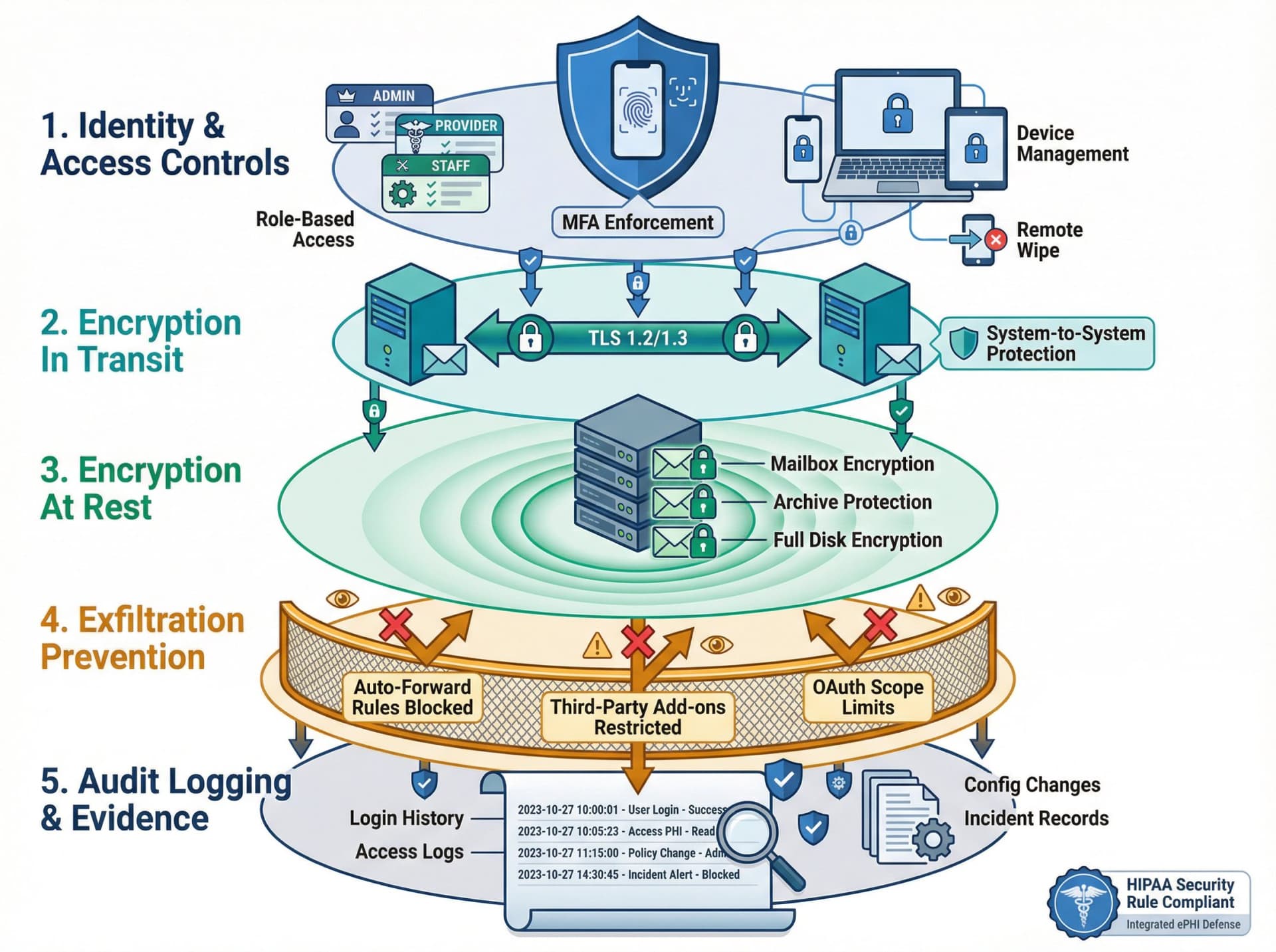
Identity and Access Controls
The proposed HIPAA Security Rule update would require MFA with limited exceptions. Don't wait for the final rule. Enforce MFA for all mailbox access and admin consoles today. Both Microsoft 365 and Google Workspace support two-factor authentication. Make it mandatory in your organization's settings, not optional. This single control prevents the majority of credential-based attacks.
Beyond MFA, only people who actually need ePHI in email should have access to it. Use role-based access controls, not shared credentials. Kill the "everyone has the shared inbox password" approach immediately. When staff leave or change roles, disable access fast. The proposed rule mentions 24-hour notifications when access is changed or terminated for certain scenarios. That should be your standard.
Email also lives on laptops, tablets, and phones, so your controls need to extend there. Implement full disk encryption on all devices that access work email, mobile device management (MDM) with remote wipe capability, lock screens with timeout policies, and regular patching and anti-malware (explicitly called out in the proposed rule). A lost phone with access to work email is a breach waiting to happen. Build controls that assume devices will be lost or stolen.
Encryption Strategy: In Transit and At Rest
You need to solve two different encryption problems.
For encryption in transit (system-to-system), TLS for mail server transport is table stakes, but it's not enough on its own. TLS can fail open depending on configuration. If the recipient's email server doesn't support TLS or uses an older version, the message could downgrade to unencrypted delivery. You also need to ensure modern TLS versions only, specifically TLS 1.2 or 1.3, not the outdated 1.0 or 1.1 versions.
For external recipients, you need stronger message-level encryption than TLS alone. Options include S/MIME or similar certificate-based encryption, a secure message portal or "message encryption" experience (common in Microsoft 365), or encrypted attachments with out-of-band password delivery as a last resort. Many HIPAA-compliant email solutions automatically encrypt every outgoing message containing PHI. If the recipient's system can't receive encrypted email directly, they provide a secure web portal where the recipient logs in to view the message.
Stored emails need encryption at rest too. Reputable providers encrypt mailbox storage on the server side by default once a BAA is in place. If you use local email storage or archives, ensure those devices have full-disk encryption enabled.
Future-proofing note: The OCR proposed rule would require encryption of ePHI at rest and in transit with limited exceptions. Build your email system to this standard now rather than retrofitting later.
Stopping Silent Exfiltration
Email has multiple paths for data to leave your control silently. Auto-forwarding to personal Gmail accounts or external domains is one of the easiest ways for PHI to leak. You need to block or heavily restrict auto-forwarding to external addresses. Beyond that, monitor and alert on new inbox rules being created, delegated access changes (someone giving another user access to their mailbox), and OAuth app grants, especially those requesting broad mail scopes. You should also require security review before enabling any third-party email plugin or integration. If the add-on reads message content, it needs a BAA if you're using it with PHI.
Audit Logging and Evidence Collection
Keep audit logs for mailbox access and admin actions. The Security Rule requires audit controls to record and examine activity in systems containing ePHI.
What you need to log and retain includes login history and device/IP information, message access (who opened or sent emails with PHI), configuration changes (DLP rules, forwarding settings, access permissions), and incident tickets and investigations. The proposed rule would require annual compliance audits and more formal testing and review cycles. Start building that documentation trail now.
You should also keep screenshots or exports of your security configurations: MFA enforcement settings, DLP policy rules, auto-forwarding restrictions, audit logging settings, and retention policy configurations. If you can't produce evidence of these controls during an audit, you effectively don't have them in the eyes of regulators.
How to Email Patients: Rights, Risks, and Best Practices
Emailing patients introduces additional complexity. You need to understand their rights and your responsibilities.
HHS's right-of-access guidance (updated May 30, 2025) is clear: individuals generally have a right to receive copies of their PHI by mail or email if they request it. You can't force patients to come in person just because you don't like email. If a patient requests unencrypted email, you must give a brief warning about transit risk and confirm they still want it. Then you must comply, assuming it doesn't introduce unacceptable risk to your own systems based on your risk analysis.
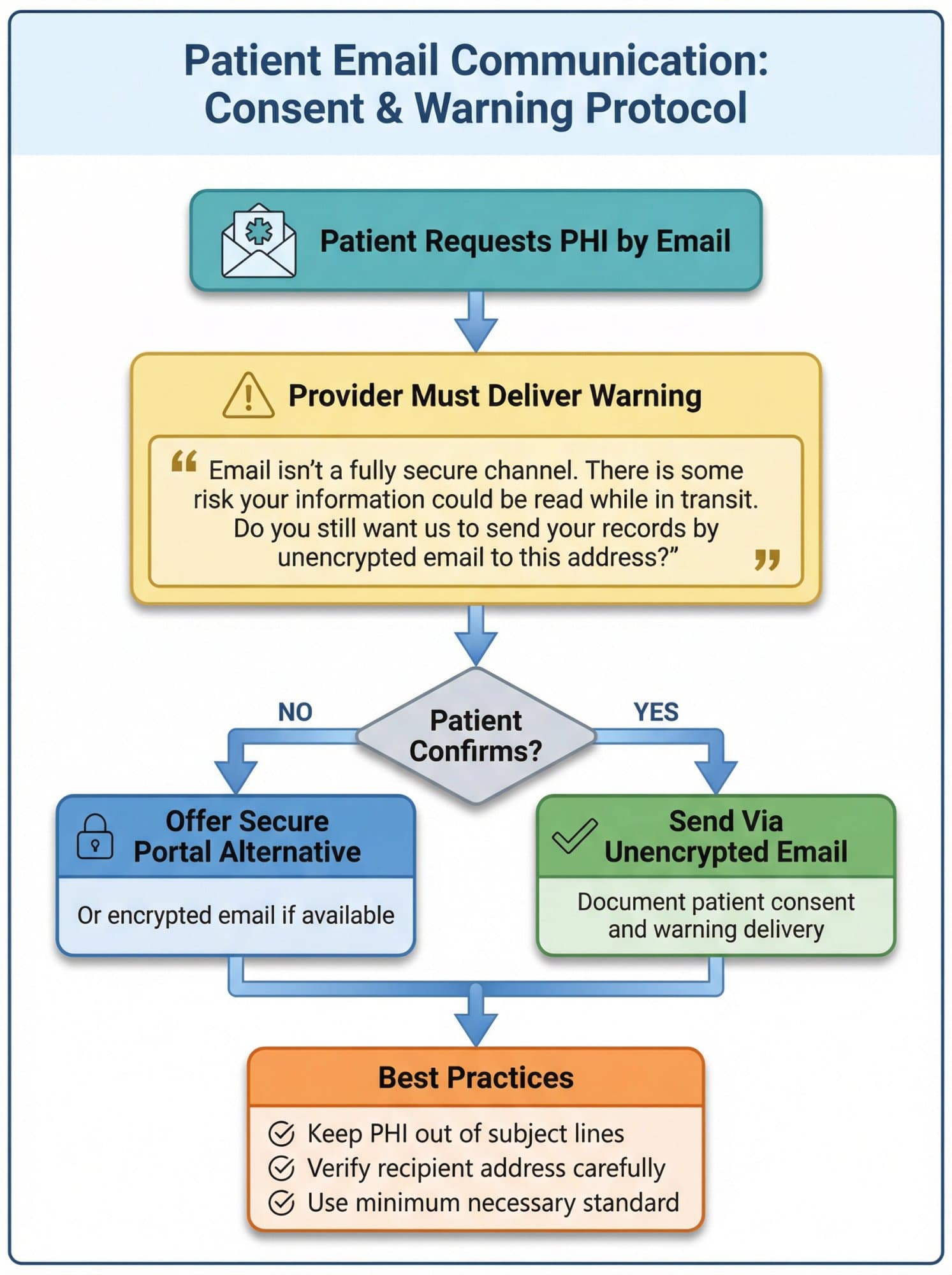
Here's a warning template you can use:
"Email isn't a fully secure channel. There is some risk your information could be read while in transit. Do you still want us to send your records by unencrypted email to this address?"
Keep the patient's "yes" response in your record.
When emailing patients, keep PHI out of subject lines since they can leak in notifications and previews. Use a "verify recipient" step for first-time email addresses because typos are disastrous. Document the patient's preference and your warning. For especially sensitive content like full medical records, imaging, or detailed lab results, prefer a secure portal instead.
Get patient consent before initiating email communication. The consent form should specify what kind of information may be emailed (appointment reminders, test results, etc.) and warn patients of residual risks. Even with consent, use the minimum necessary standard. Instead of emailing detailed lab results directly, consider sending a notification: "Your test results are available on our secure portal." This limits what's exposed if someone other than the patient sees the email.
Using AI Email Tools with HIPAA: Safe Deployment
AI-powered email tools can dramatically improve productivity, but they introduce new compliance considerations when PHI is involved.
If an AI feature reads or drafts emails containing PHI, that processing can make the AI vendor (or the hosted tool vendor) part of your PHI chain. You must evaluate whether a BAA is required and whether the data use and retention terms are acceptable. This is the same business associate logic HHS applies generally. If the vendor processes your ePHI, you need a contract that ensures HIPAA protections.
Inbox Zero: A HIPAA-Conscious Email Management Solution
We built Inbox Zero specifically with these concerns in mind. It's an open-source AI email assistant that works with Gmail and Microsoft 365 through OAuth and standard mail APIs. The repository on GitHub currently has 9.9k stars and 1.2k forks, demonstrating strong community validation and transparent development practices. The code is TypeScript-based and fully inspectable, which matters when you're vetting tools for security-critical environments.
| Requirement | How Inbox Zero Delivers |
|---|---|
| BAA | SOC 2 compliant for hosted service; self-host option eliminates third-party data handling entirely |
| Encryption | Works with Gmail/M365's native encryption; no additional message handling that could bypass security |
| Audit Logs | Comprehensive logging of rule triggers, drafts created, label actions |
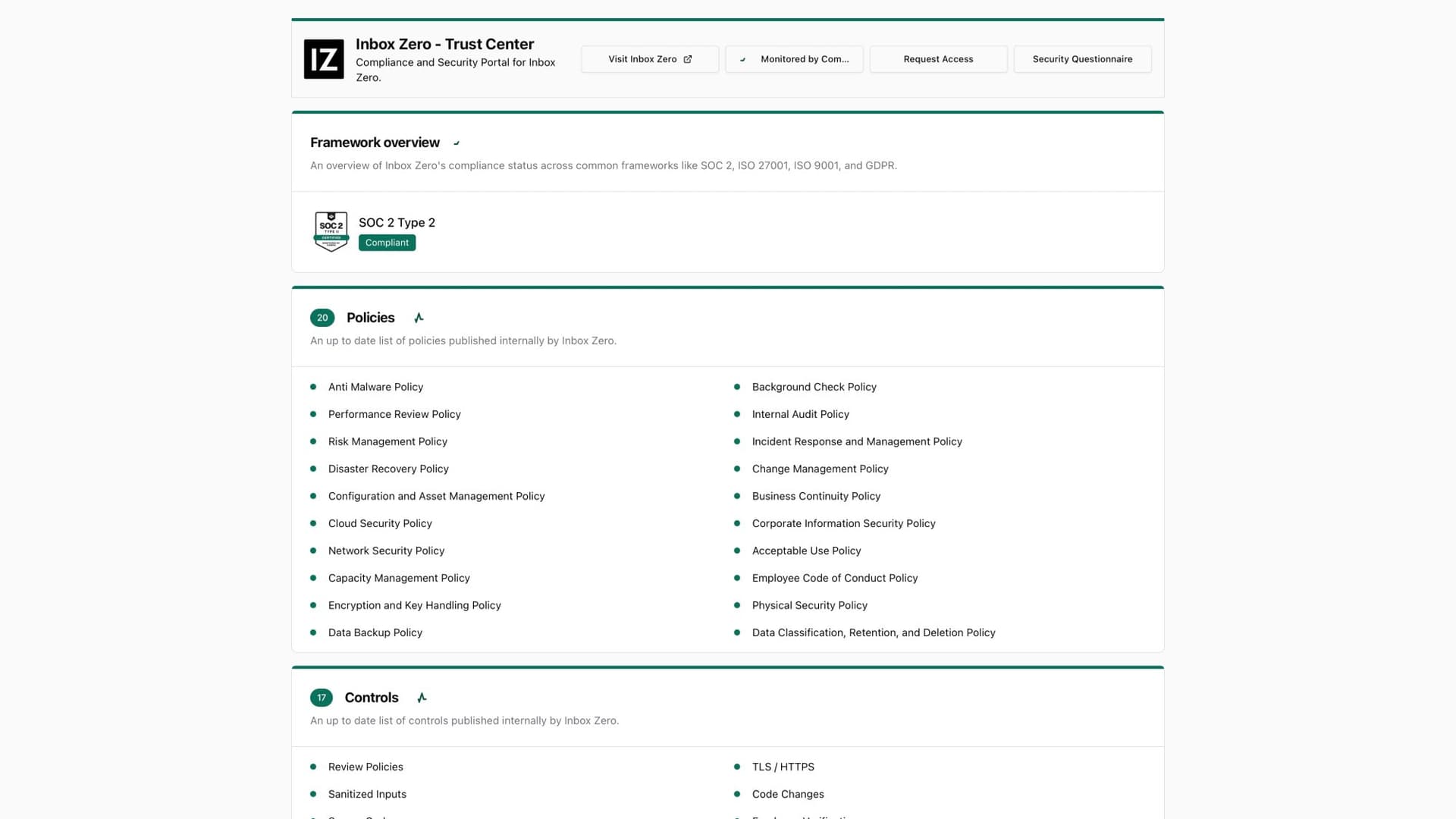
| Security Certifications | SOC 2 compliant; open source allows independent security review |
| Data Transparency | Full transparency on AI provider usage; option to use local models (Ollama) with zero external calls |
| Control & Privacy | Self-hosted deployment keeps all data on your infrastructure |
Inbox Zero supports self-hosting through Docker and local deployment paths, meaning you can run the entire system on your own infrastructure and keep all email data within your controlled environment. There's no requirement to send PHI to any third-party service. For organizations that prefer the hosted service, we maintain SOC 2 compliance, providing the security posture that healthcare organizations expect from vendors handling sensitive data.
On the AI side, Inbox Zero supports multiple providers including Anthropic, OpenAI, Google, Groq, OpenRouter, and critically, Ollama for local model execution. This means you can run AI email management entirely on-premise with no external API calls if your compliance requirements demand it. Whether that meets your compliance bar depends on your environment and contracts, but the flexibility to choose matters.
You can also configure Inbox Zero to never auto-send messages. Instead, it drafts replies and labels emails, requiring human review before anything goes out. This draft-only mode is critical when dealing with patient communications. On top of that, you can build rules that refuse to summarize or draft if certain patterns appear (medical record number formats, diagnosis terms, "lab result," etc.) and route those emails to a "needs manual handling" label instead. Every label action, draft creation, and rule trigger is logged, giving you a comprehensive audit trail you can show auditors.
Safe Deployment Patterns for Any AI Email Tool
Whether you use Inbox Zero or another solution, start with low-risk categories. Scope automation to newsletters, receipts, and operational mail that doesn't contain PHI. Keep anything patient-related in "label and alert" mode initially.
Build PHI detection rules that catch common patterns (patient names combined with clinical terms, MRN formats, etc.) and route detected messages to manual review instead of automated processing. Flag potential PHI for human verification before any AI processing takes place.
If you're processing emails with PHI through AI, evaluate the data handling terms carefully. Can you bring your own API keys? Does the provider sign BAAs? What's their data retention policy? Local model execution (like Ollama) eliminates third-party data exposure entirely, though model quality may differ from cloud-hosted alternatives.
Maintain audit trails of which messages were processed by AI, what actions were taken (draft created, label applied, etc.), which human reviewed and approved those actions, and any PHI detection rule triggers.
Gmail Organization Without Cloud Processing
If you want better inbox organization without sending any data to external servers, Inbox Zero also offers a Chrome extension that adds custom tabs to Gmail. The extension is positioned as 100% private and operates entirely within your browser. All settings are stored locally using browser storage, with no server calls, no data collection, and no external dependencies. Learn more about Inbox Zero's Tabs extension.
A HIPAA note on client-side tools: "client-side only" is good for data privacy, but device security and account security still matter. A compromised laptop still compromises email access. Make sure devices using the extension have proper encryption and security controls.
Questions Every HIPAA Email Audit Will Ask
The HIPAA Security Rule requires covered entities to conduct an "accurate and thorough assessment" of risks to the confidentiality, integrity, and availability of ePHI. OCR points to NIST guidance as the industry standard playbook. Your risk analysis needs to cover email specifically. These are the prompts auditors will expect you to have answered.
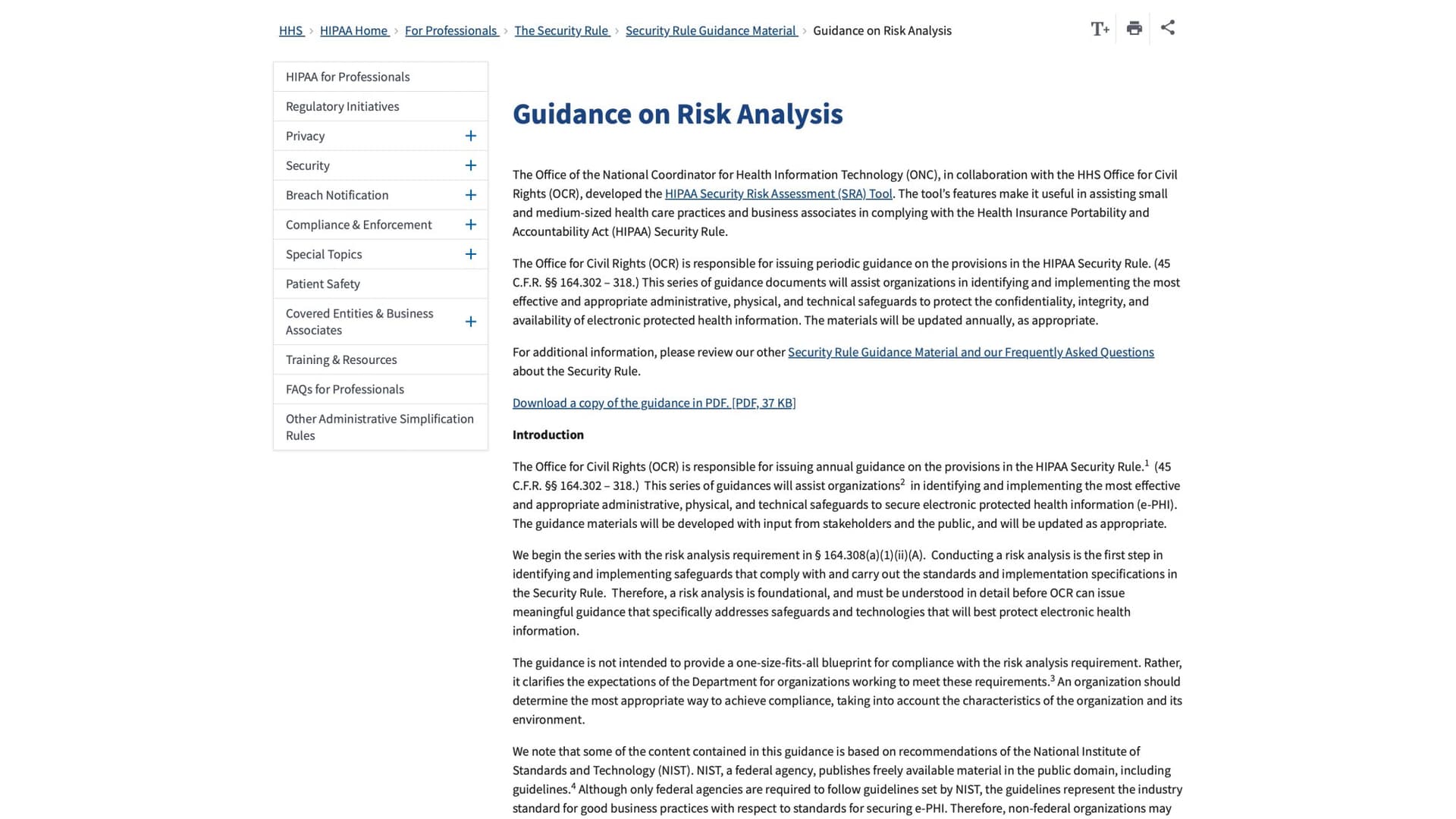
Where does ePHI show up in email? It lives in inboxes (sent, received, drafts), shared mailboxes, email archives and backups, mobile devices syncing email, local .PST or .OST files, and third-party systems that access email via API.
Who can access it? Think about employees and their permission levels, contractors and temporary staff, delegated access (assistants managing someone's inbox), IT administrators, and vendors with API access.
How does it leave your control? Through email forwarding (manual and automatic), attachments sent externally, mobile device auto-sync, data exports (downloading mailboxes), third-party add-ons and integrations, and print-to-PDF or local saves.
How is it protected in transit and at rest? You need to account for TLS encryption for transport (version and configuration), message-level encryption for external sends, server-side encryption at rest, device encryption for endpoints, and backup encryption.
What logs exist to detect and investigate incidents? Auditors will look for access logs (who logged in, from where, when), admin action logs (permission changes, rule modifications), forwarding rule creation and changes, and OAuth app authorization grants.
What's your phishing and credential theft exposure? Evaluate your MFA enforcement status, conditional access policies, training frequency and effectiveness, phishing simulation results, and password policy strength.
What's the blast radius if one mailbox is compromised? Consider shared inboxes and delegated access, auto-forwarding rules attackers could create, OAuth apps with broad permissions, and the volume of email accessible from the compromised account.
At the end of this analysis, you want a risk register listing your top 10 email-related risks. Each entry should document the likelihood (low/medium/high), the impact (low/medium/high), the risk owner, current mitigation controls, and planned remediation with target dates. You also need to show this isn't a one-time document. Include periodic review dates and updated risk assessments.
How to Configure Gmail and Microsoft 365 for HIPAA
Both Google Workspace and Microsoft 365 can be used for HIPAA workloads, but only when properly configured and contracted.
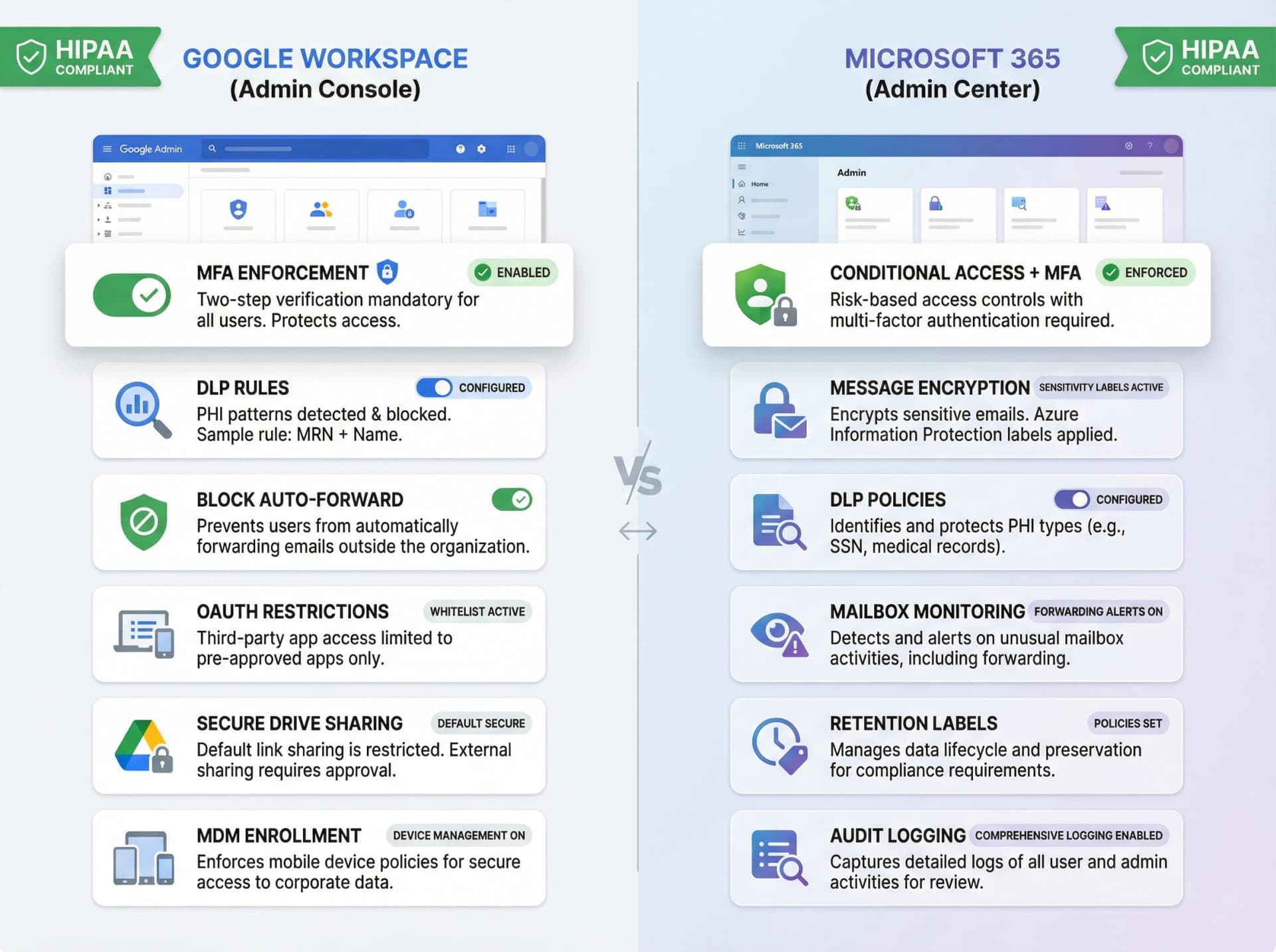
Google Workspace Configuration for HIPAA
Google provides HIPAA implementation guidance for Workspace (updated May 29, 2025). The core theme: use the right covered services, configure them correctly, and execute the contractual steps including a BAA.
For email specifically, enforce MFA for all users through admin console security settings. Configure DLP rules for common PHI patterns (names combined with medical record numbers, claim numbers, diagnosis codes). Block external auto-forwarding to prevent silent data exfiltration. Restrict OAuth app access and third-party add-ons through allowlisting. Use secure sharing defaults for Google Drive links if you send links via email, and manage mobile devices (MDM) if Gmail is accessed on phones or tablets.
Microsoft 365 Configuration for HIPAA
Microsoft's compliance documentation positions Microsoft 365 as supporting HIPAA/HITECH-aligned capabilities when configured appropriately (updated October 29, 2024).
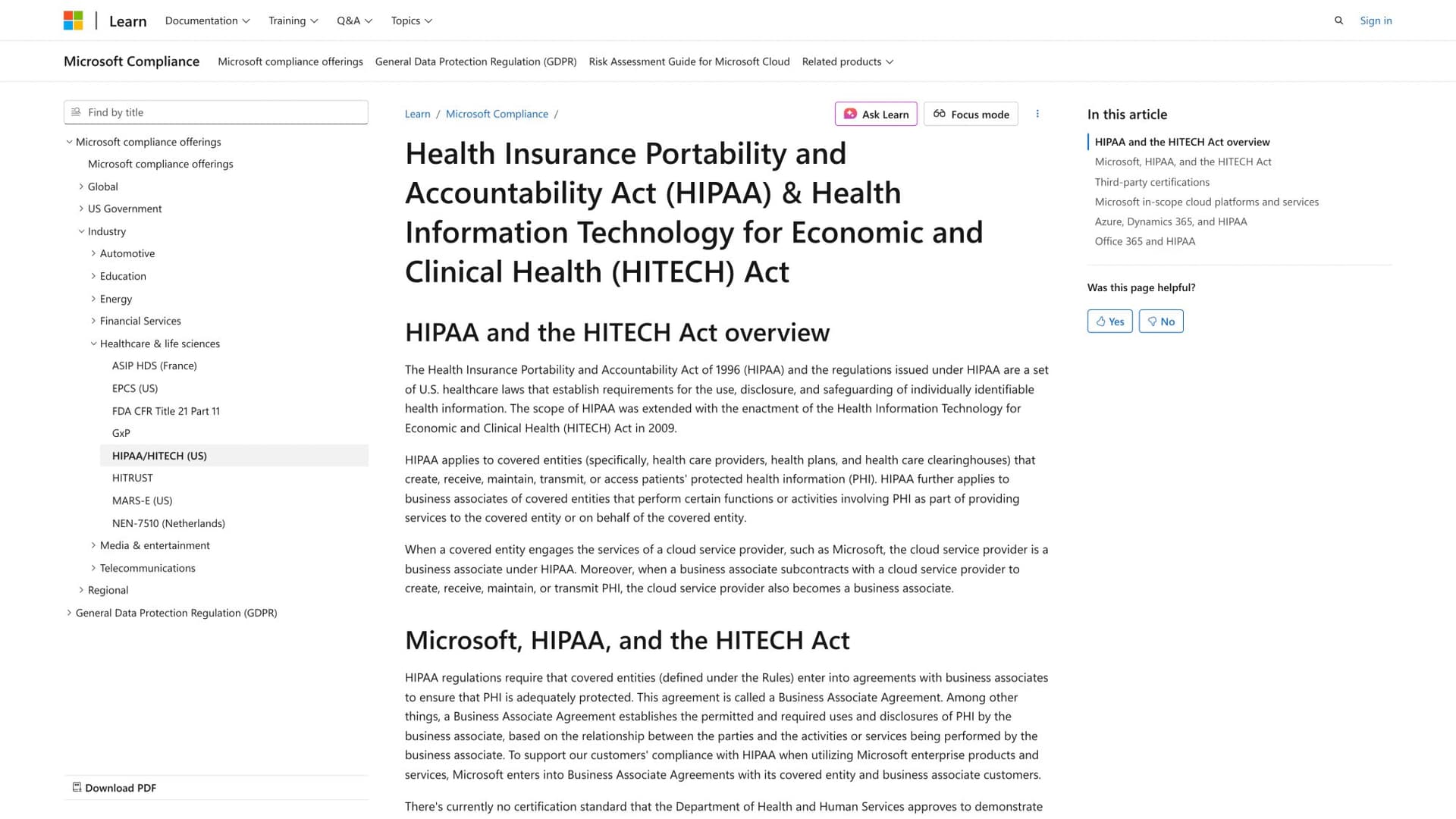
For email, you'll want conditional access combined with MFA to enforce authentication controls. Use Office Message Encryption or sensitivity labels for external email sharing, and set up DLP policies for PHI using built-in or custom sensitive info types. Enable mailbox rule monitoring to detect unauthorized forwarding or delegation, apply retention labels for mailboxes and shared mailboxes, and turn on audit logging for mailbox access and administrative actions.
Most Common Email Mistakes That Become HIPAA Violations
Despite your best intentions, a few common mistakes account for many email-related HIPAA breaches. Knowing the top scenarios helps you build better defenses.
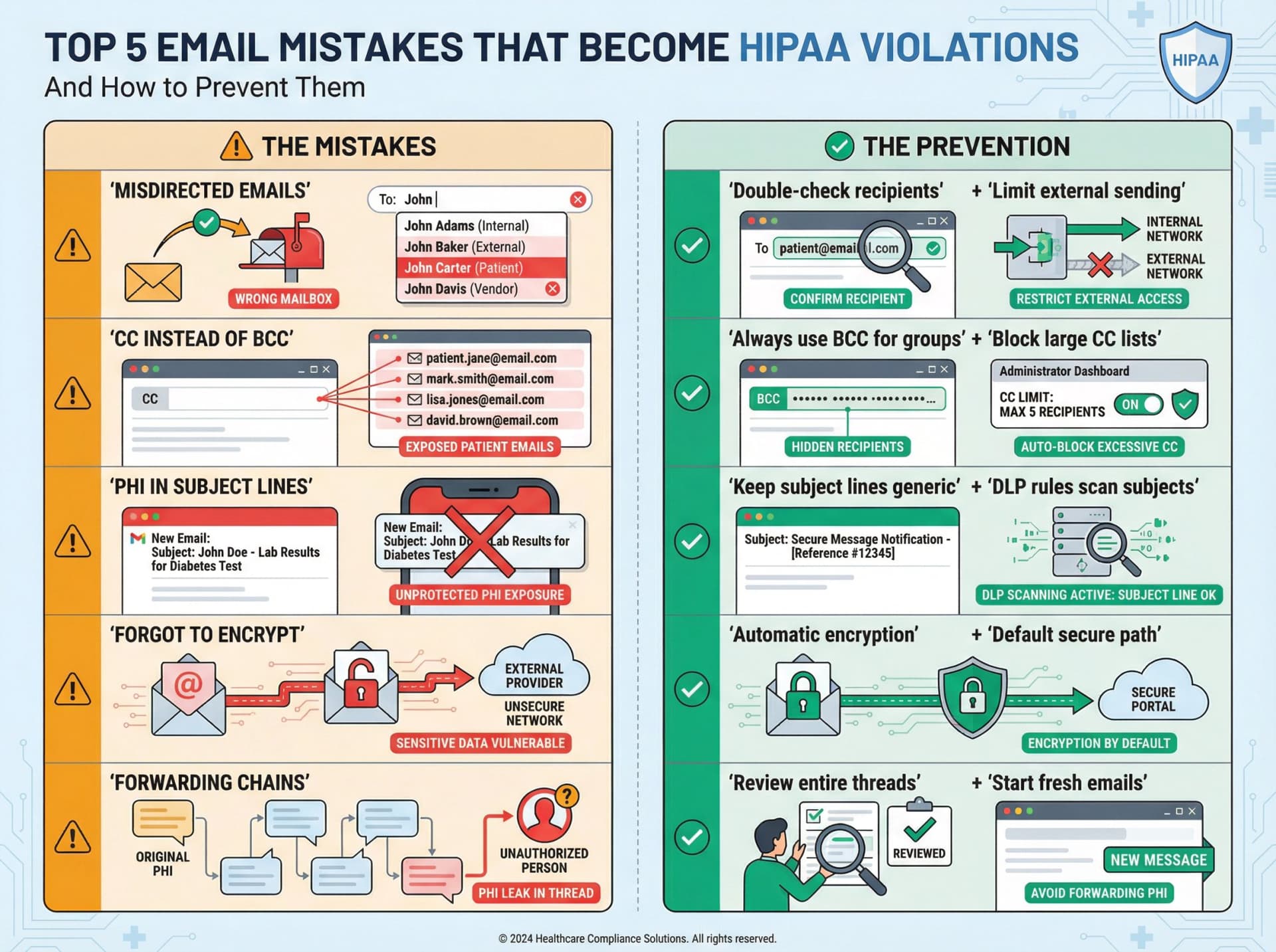
Misdirected Emails (Wrong Recipient)
Autocomplete betrayal is one of the simplest and most frequent errors. Someone types "John" into the To field, and their email client helpfully suggests three different Johns. They pick the wrong one. Train staff to verify recipients before hitting send (double-check every external address). For high-risk roles, limit external sending permissions. Implement DLP warnings that trigger when PHI patterns are detected in emails to external domains, and consider disabling autocomplete for external addresses.
CC Instead of BCC for Patient Groups
If you send one email to multiple patients (a group flu shot reminder, for example), using CC reveals each recipient to all the others. That's a privacy breach. Each patient can now see who else is a patient at your practice. Always use BCC for group patient communications. Better yet, use a proper patient communication platform that sends individual emails. Block large CC lists in your email gateway if possible.
PHI in Subject Lines
Subject lines often appear in notification previews, forwarded message headers, and email client previews. They may not be encrypted even when the body is. A subject line like "John Doe - Lab Results for Diabetes Test" is a glaring violation. Establish a policy to keep subject lines generic, create DLP rules that scan for patient names or clinical terms in subject lines, and reinforce training with specific examples of good versus bad subject lines.
Forgetting to Encrypt External Emails
A busy staff member dashes off an email with PHI to an external provider, not realizing it's going out unencrypted. Automatic encryption is key here. Don't rely on humans to remember an extra step. Use email gateways or add-ons that encrypt by default when PHI patterns are detected. Make the secure path the default path.
Forwarding Chains Without Review
People often forward an email thread to loop in someone new, not realizing earlier messages in the chain contained PHI that the new recipient shouldn't see. Train staff to review entire threads before forwarding. Better yet, start a fresh email when bringing in new recipients and strip out old messages that contain unnecessary PHI.
Email Retention and Cleanup: How to Store Emails Safely
HIPAA doesn't provide one simple "keep emails for X years" rule. Instead, it requires you to retain required documentation for six years, and you must comply with other applicable laws and contracts. Medical record retention is often driven by state law.
Email retention is really about three things: making sure you can produce required information when asked, not deleting records you were supposed to keep, and not keeping sensitive data forever just "because storage is cheap."
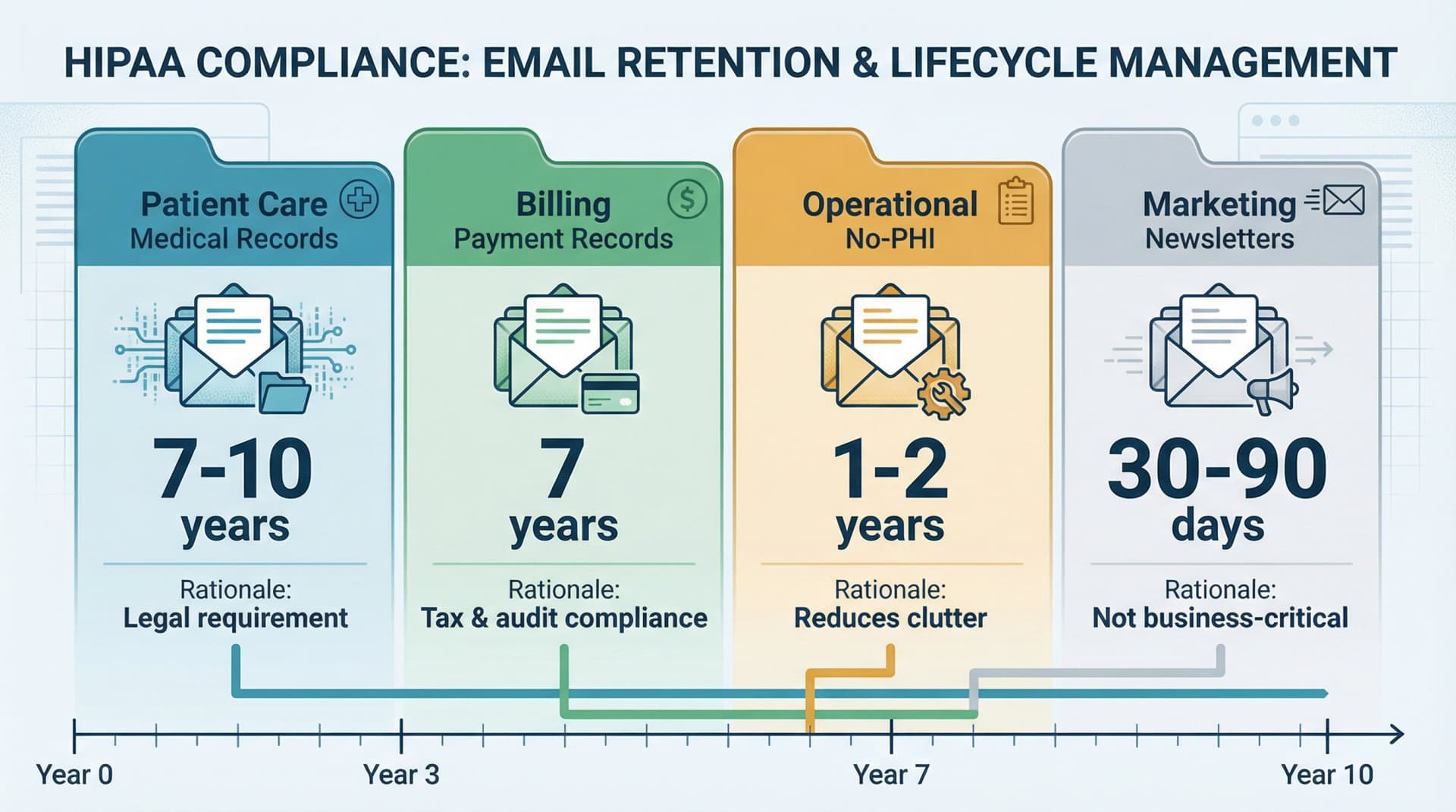
The best practice is to define categories and apply different retention policies.
| Category | Retention Period | Rationale |
|---|---|---|
| Patient care / medical records | Per state law (often 7-10 years) | Legal requirement |
| Billing / payment records | 7 years minimum | Tax and audit compliance |
| Operational (no PHI) | 1-2 years | Reduces clutter |
| Marketing / newsletters | 30-90 days | Not business-critical |
Apply retention policies differently per category and implement legal holds for disputes, investigations, or litigation.
One important caveat: the inbox zero method as a personal productivity habit can conflict with retention requirements if you treat "delete everything" as the goal. For HIPAA purposes, the goal is structured storage and controlled deletion, not indiscriminate purging. Learn more about how to manage your inbox while maintaining compliance.
What to Do When Someone Emails PHI to the Wrong Person
When (not if) someone sends PHI to the wrong person, how you respond determines the scope of the damage and your regulatory exposure. Print this runbook and keep it accessible.
Step 1: Contain
If your platform supports recall or undo send, attempt it immediately. If compromise is suspected (hacked account), disable auto-forwarding rules. If the wrong recipient is known, request deletion and written confirmation.
Step 2: Preserve Evidence
Save the sent message, headers, recipient list, and timeline. Log who discovered the incident and when. Document all containment actions taken.
Step 3: Risk Assessment
Ask what PHI was involved (patient names, diagnoses, MRNs, etc.), who received it and what's the likelihood of further disclosure, and whether it was encrypted or secured per HHS guidance (encryption can affect breach notification obligations).
Step 4: Notification Decision
The Breach Notification Rule has different thresholds. If fewer than 500 individuals are affected, notify each patient without unreasonable delay (no later than 60 days from discovery) and submit an annual report to HHS. If 500 or more individuals are affected, notify HHS within 60 days and notify prominent media outlets in the region. This is a huge reputational hit, which is why prevention is so critical.
Step 5: Remediation
Update DLP rules, training, or sending permissions based on root cause. Document everything, because the thoroughness of your response can reduce penalties.
HIPAA fines can reach up to $2 million per violation category under 2025's adjusted figures. Organizations have faced multi-million dollar settlements after email breaches. One New York medical center paid $4.75 million after a series of email-related incidents. And that's just the fine. Legal fees, remediation costs, and lost reputation can far exceed the penalty itself.
How to Build Your Audit-Ready Evidence Pack
Auditors don't want to hear what you intended to do or what you think is configured. They want evidence.
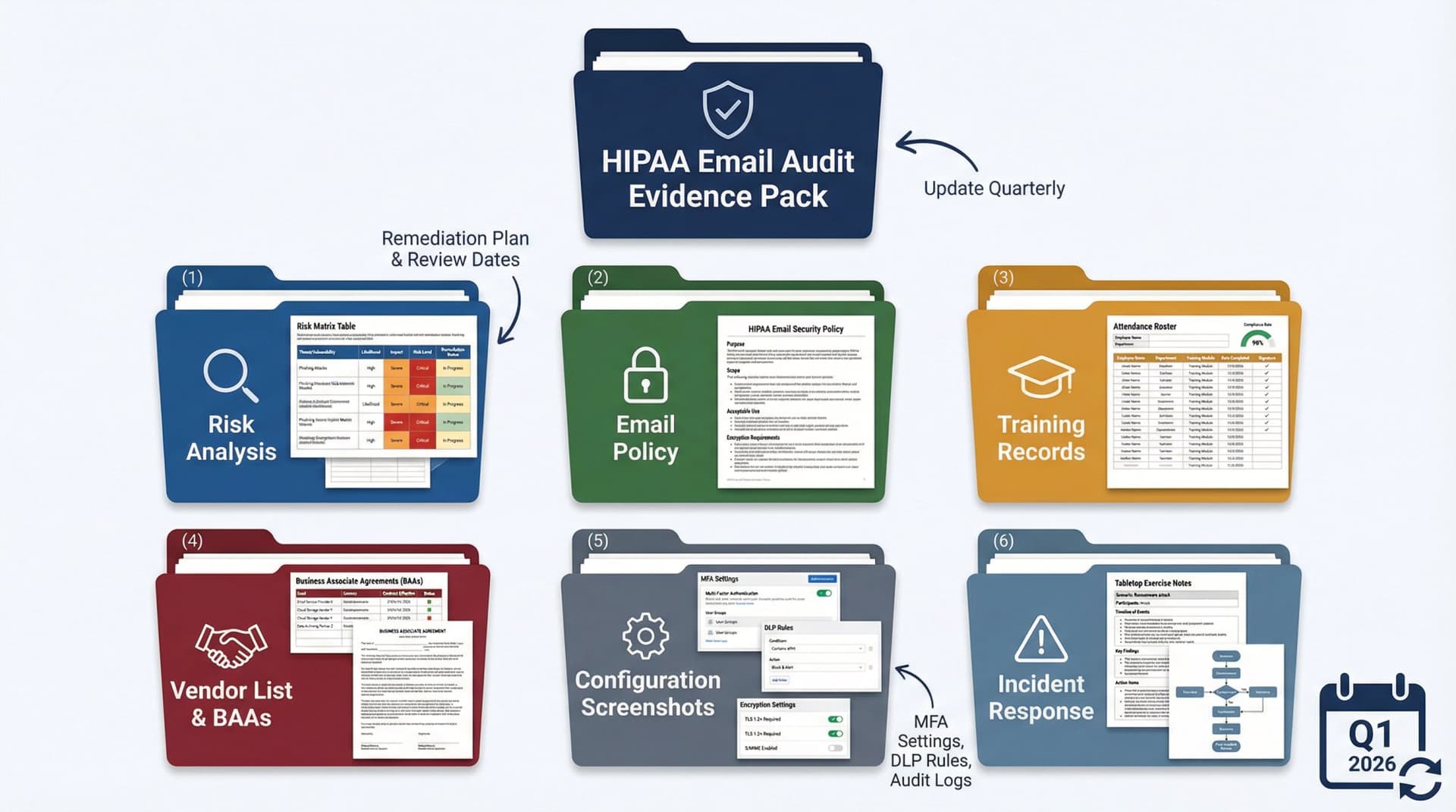
Keep these in a single folder and update quarterly: your latest risk analysis with remediation plan and review dates, a written email policy covering when email is allowed, encryption requirements, and minimum necessary guidelines, training materials and attendance logs showing who was trained and when, a vendor list that touches PHI with BAA status clearly marked, configuration screenshots or exports showing MFA enforcement, DLP policy rules, auto-forwarding restrictions, audit logging, and retention policy configurations, an incident response plan with last tabletop exercise notes, and your retention policy documentation with legal hold process.
The proposed HIPAA Security Rule update would require annual compliance audits and more formal testing and review cycles. Start building this documentation habit now.
14-Day HIPAA Email Compliance Roadmap
You don't need months to get the basics right. This is a realistic two-week sprint to move from risky to defensible.
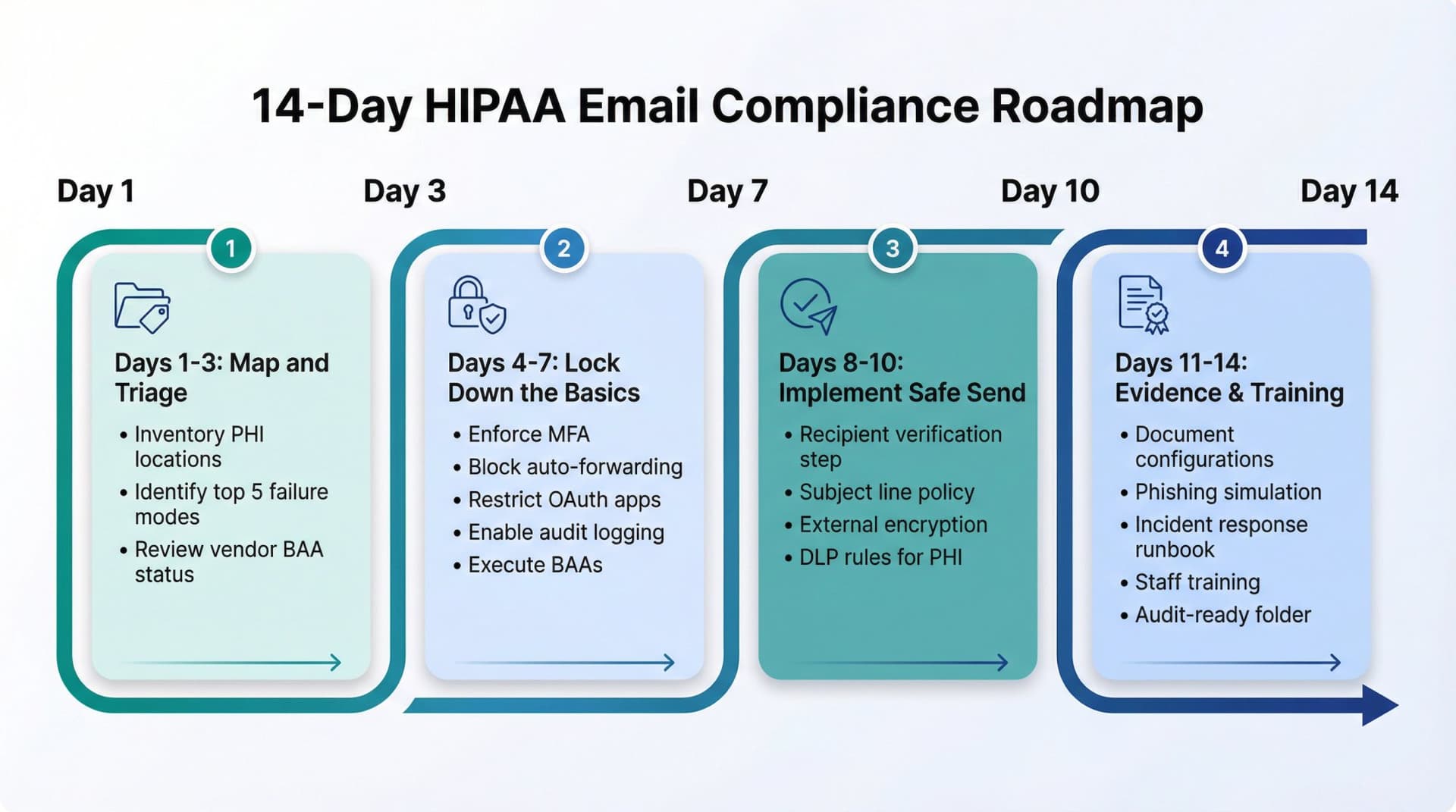
Days 1-3: Map and Triage. Inventory where PHI appears in email (inboxes, shared mailboxes, archives, mobile devices). Identify your top 5 failure modes (wrong recipient, CC instead of BCC, unencrypted external sends, etc.). Review current vendor list and BAA status.
Days 4-7: Lock Down the Basics. Enforce MFA on all accounts. Block external auto-forwarding or heavily restrict it. Restrict third-party OAuth app access. Enable and verify audit logging. Execute BAAs with email providers if not already in place.
Days 8-10: Implement the Safe Send Workflow. Create a recipient verification step for external emails. Document and train staff on subject line policy (keep PHI out). Choose and implement your encryption approach for external sends (secure portal, S/MIME, or encrypted email service). Set up DLP rules for common PHI patterns.
Days 11-14: Evidence and Training. Document all configurations with screenshots or config exports. Run a phishing simulation and misdirected email tabletop exercise. Finalize your incident response runbook. Conduct email-specific HIPAA training for all staff with PHI access. Create your audit-ready evidence folder.
How to Choose HIPAA-Compliant Email Tools
Not all email tools are created equal when it comes to HIPAA compliance. Here's what to evaluate when selecting solutions.
The vendor must be willing to sign a Business Associate Agreement. If they won't, they're not suitable for use with PHI. Period.
For encryption capabilities, look for TLS 1.2 or 1.3 for transport, message-level encryption (end-to-end or secure portal delivery), and encryption at rest for stored messages. You also need detailed audit logging of access, actions, and changes. You should be able to answer "who accessed this message, when, and from where?"
Look for vendors with SOC 2, ISO 27001, or similar attestations. These demonstrate the vendor maintains security controls and undergoes independent audits.
Ask vendors pointed questions about data handling transparency: What happens to your email data? Is it used for training AI models? Which AI provider do they use? What's the data retention policy? Can you bring your own API keys? What happens to your data if you cancel?
Open-source tools like Inbox Zero offer a unique benefit: full code transparency. Security teams can inspect exactly how data is processed, with no hidden behaviors or undisclosed data flows. For organizations with strict compliance requirements, the ability to self-host means you maintain complete control over where data lives and who has access.
Frequently Asked Questions
Does HIPAA require email encryption?
Today, encryption is "addressable" under the Security Rule, meaning you must implement it if reasonable and appropriate, or document an alternative. But OCR has proposed making encryption of ePHI at rest and in transit required with limited exceptions. Build as if it's mandatory.
Can patients request unencrypted email?
Yes. HHS says individuals have a right to receive PHI by unencrypted email if they request it, as long as you warn them about transit risk and they accept it. You must comply unless it introduces unacceptable risk to your own systems.
Can we use Google Workspace or Microsoft 365 for HIPAA?
Both can be HIPAA-compliant when properly configured and when you execute a BAA. Google publishes HIPAA implementation guidance for Workspace. Free consumer accounts (free Gmail, free Outlook.com) cannot be used for PHI because those vendors won't sign BAAs for free tiers.
If we self-host an email tool, are we automatically compliant?
No. Self-hosting reduces vendor exposure, but you still need to secure the hosting environment, conduct risk analysis, manage access controls, log actions, and handle any third parties (email provider, model provider, hosting provider) that may touch ePHI. Self-hosting gives you more control, not automatic compliance.
What about Gmail Confidential Mode?
Gmail Confidential Mode is not HIPAA-compliant on its own. It prevents easy forwarding and adds expiration, but it doesn't provide the level of encryption HIPAA requires. Use proper encrypted email services instead.
Conclusion: Compliance as Continuous Commitment
HIPAA-compliant email management requires a blend of technology, policy, and ongoing vigilance. You can't "set it and forget it." What was secure in 2023 might need updates in 2026 as threats evolve and regulations adapt.
By using a HIPAA-compliant email service with strong encryption, locking down access with MFA and audit controls, training your staff on safe email habits, and staying prepared for potential incidents, you significantly reduce breach risk.
Make HIPAA email compliance part of your organization's culture. Everyone from executives to front-line staff should understand why these rules matter. It's about protecting patients' privacy and your organization's integrity.
Don't shy away from tools that can enhance both security and efficiency simultaneously. Modern solutions like Inbox Zero can encrypt emails behind the scenes, provide PHI detection and routing, automate low-risk tasks, and maintain comprehensive audit trails.
The key is thorough vetting. Look for tools with strong security credentials (SOC 2, ISO 27001), willingness to sign BAAs, and transparency about data handling. In some cases, an open-source solution you can control directly might offer the best of both worlds: improved email productivity plus full visibility into data handling.
By following the best practices in this guide, you'll build an email management program that not only meets HIPAA requirements but also gives patients confidence that their sensitive information is in good hands. In an age where email is indispensable for healthcare communication, that confidence is worth its weight in gold.
Stay current: the recommendations above reflect 2026 regulations and best practices. HHS's proposed Security Rule updates may soon become requirements. Staying informed and proactive is part of best practice itself.
Ready to implement a HIPAA-conscious email management solution? Explore Inbox Zero's features and documentation to see how we can help you achieve both compliance and productivity.

Relay.app Is Shutting Down: Deadlines, Data Export, and Alternatives
Relay.app is shutting down in 2026. See the deadlines for free and paid users, what to export, and which alternatives fit your email and automation workflows.
2026-07-16T18:46:02Z
Best AI Email Assistants in 2026 (Tested)
The best AI email assistants in 2026, tested and compared. Honest pros, cons, and pricing for Inbox Zero, Superhuman, Fyxer, Shortwave, Lindy, Missive, SaneBox, Serif, Perplexity, Gemini in Gmail, and Microsoft Copilot, with picks by use case.
2026-07-05T08:00:00Z

Top 16 Email Management Software of 2026
Discover the top 16 email management software of 2025 designed to boost productivity and simplify your inbox.
2026-06-24T09:00:00Z
7 Best Fyxer Alternatives in 2026
The best Fyxer.ai alternatives in 2026, compared. AI email assistants, team inboxes, and inbox cleaners, with honest notes on price, features, and who each one is for.
2026-06-01T08:00:00.000Z