Best Serif Alternative in 2026: Inbox Zero Comparison
Comparing Serif with Inbox Zero
An AI executive assistant that triages your inbox and drafts replies in your voice, with a built-in meeting recorder and task manager. It's closed source and costs more than Inbox Zero at the entry tier.
Inbox Zero and Serif are both AI email assistants. They triage your inbox and draft replies that sound like you. Serif leans into the executive assistant angle, with a meeting recorder and a task manager built in. The real question isn't which one works, because both do. It's which one fits how you run your inbox, and what you get for the price.
Serif starts at $30 per month. Inbox Zero is $20, with an AI meeting notetaker on its Plus plan. The feature that might pull you toward Serif is its task manager. If you have that covered, or don't need it, Inbox Zero does more across email itself for less money, and it's open source so you can see exactly how your mail is handled. It also holds up against the best AI email assistants overall.
Here's the feature by feature breakdown.
Pricing
Serif publishes its prices, which is good. The Lite plan is $30 per month and includes the meeting recorder, task manager, knowledge base, and email triage. Standard is $50 per month and adds True Voice plus more usage. Pro is $200 per month for heavy users, and Team is $50 per user per month with pooled usage and admin controls. Enterprise is custom. Every plan has a 7-day free trial. Inbox Zero starts at $20 per month.
| Plan | Price | Includes |
|---|---|---|
| Serif Lite | $30/mo | Meeting recorder, task manager, triage, drafting |
| Serif Standard | $50/mo | Lite plus True Voice and more usage |
| Serif Pro | $200/mo | Standard plus high usage and dedicated support |
| Serif Team | $50/user/mo | Standard plus pooled usage and admin |
| Inbox Zero | $20/mo | Full feature set |
The gap matters more than it looks, because you pay per seat. Serif is 50% more expensive at the entry level, and that difference repeats for every person you add. For a five person team that's roughly $1,800 a year on Serif Lite versus $1,200 on Inbox Zero, before anyone moves up a tier.
Drafting replies
This is the headline feature for both products, and both do it well. They learn from your email history and write replies that sound like you, ready the moment a new email lands. Serif calls its higher-tier version True Voice, which sits on the $50 Standard plan rather than the $30 entry plan.
Where they split is customization. Inbox Zero gives you a full knowledge base on every plan. You can tell the assistant exactly how to handle different situations, feed it the context it needs, and connect other sources so the drafts get smarter over time. Serif has a knowledge base too, so on this point the two are close.
Most people won't need to go deep here. But if you want the assistant to know your pricing, your policies, or details from your CRM before it drafts a reply, both support that idea, and Inbox Zero includes its version without a tier upgrade.
Triage and categorization
Both tools sort incoming email and flag what needs your attention. Serif triages your inbox, summarizes important threads, and surfaces action items. For a lot of people that's enough.
Inbox Zero does the same, but you can also set your own categories. Want a Travel label, or a label for a specific client? You create it. The bigger difference is actions. In Inbox Zero you decide what happens to an email once it's sorted, not just where it lands. Want every receipt forwarded to your accountant automatically? You can set that up. Serif sorts and summarizes, but it doesn't give you that kind of custom rule on top.
Custom rules and actions
Where Serif stops at triage, Inbox Zero lets you build rules that act on email automatically. A few examples of what people set up:
- When an email from an important client mentions "contract", mark it as priority and send a Slack notification
- Archive newsletters after a week unless you've starred them
- Forward invoices to your bookkeeper and label them as processed
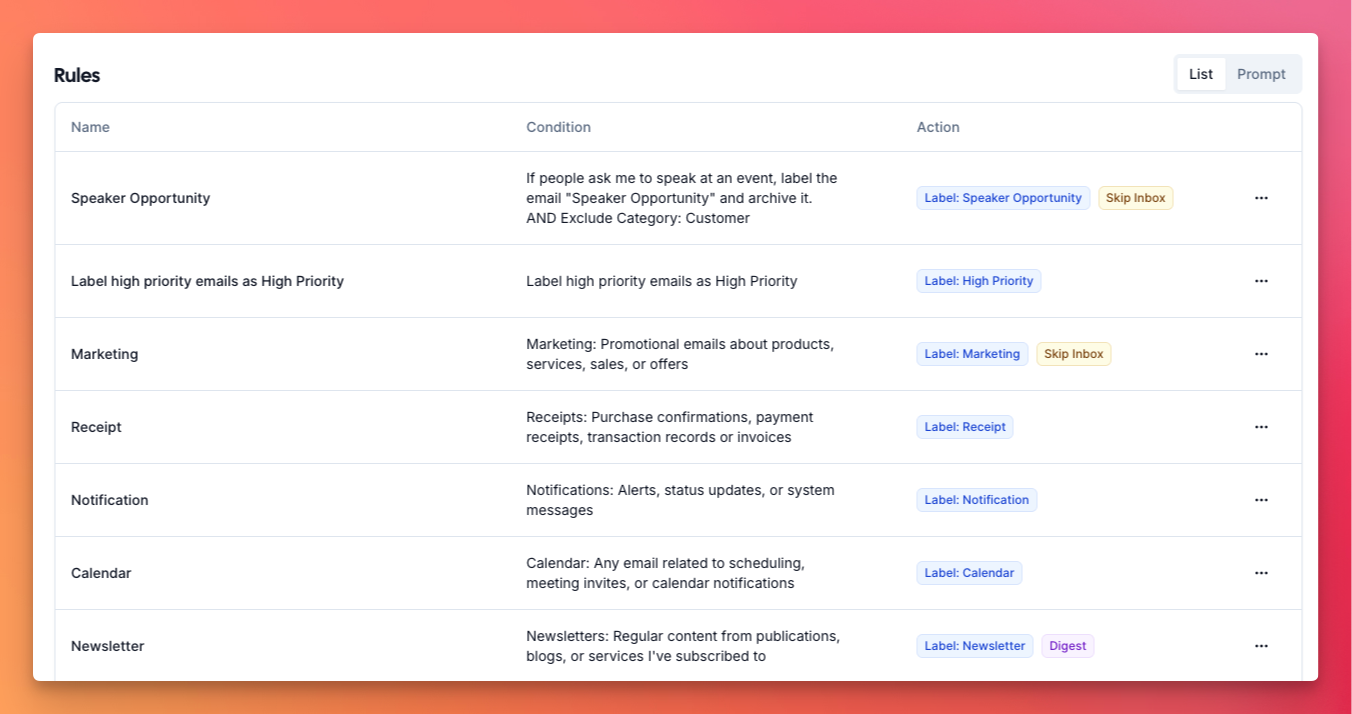
The built-in assistant can create these from plain English. Tell it "keep my inbox clean by archiving marketing emails older than a week" and it writes the rule for you. Serif has no equivalent custom action layer.
Scheduling meetings
Both handle scheduling. If someone emails asking to meet at 5pm tomorrow, both check your real calendar availability and reply accordingly. Ask "when are you free this week?" and the assistant comes back with actual open slots.
Both also let you share a booking link. With Inbox Zero you can drop in your existing Calendly or cal.com link instead of building a new one. Scheduling is solid on either tool.
Follow-ups
Both products draft follow-ups when someone hasn't replied to you. You emailed a client five days ago and heard nothing, so the assistant drafts a nudge.
Inbox Zero takes this further in two ways. First, it also reminds you when you're the one who went quiet. An important email came in last week and you never replied, so it gets labeled as needing a follow-up. Second, if you've connected Slack or Microsoft Teams, Inbox Zero can ping you there, so reminders don't just sit in the inbox you're already behind on.
Meeting recorder and notetaker
Both products include one. Serif's meeting recorder captures your calls and helps with follow-up. Inbox Zero's AI meeting notetaker, included with the Plus plan, joins your calls, writes the notes with decisions and action items, emails you a recap, and drops a follow-up draft in your inbox.
Because it's the same assistant that drafts your replies, what was agreed on your calls also feeds the emails Inbox Zero writes for you afterwards.
Task manager
Serif also bundles a task manager, so action items it pulls from your inbox can become tasks you track in one place. Inbox Zero doesn't ship a separate task manager. It focuses on acting on the email itself, through rules, drafts, and follow-up reminders, rather than maintaining a task list alongside it. If a built-in task list is something you want, that's a point for Serif.
Bulk unsubscribe and bulk archive
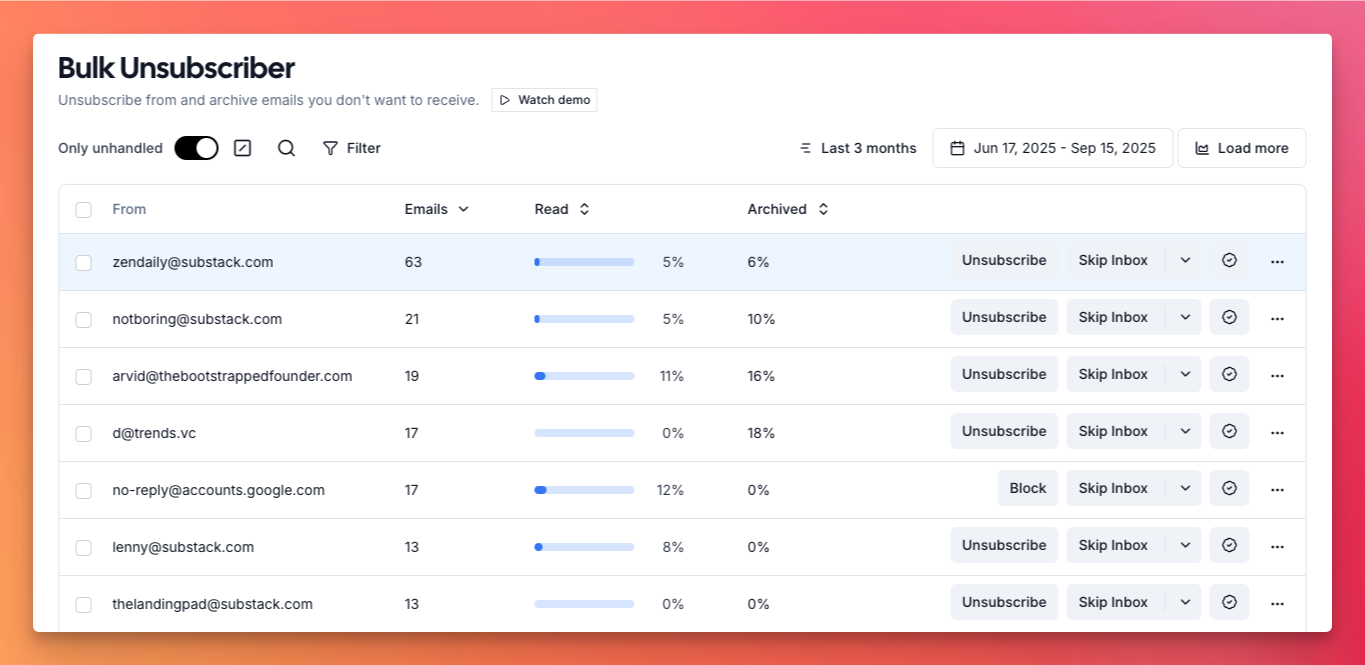
This is Inbox Zero only, and it's one of the fastest ways to clean out a messy inbox.
Bulk unsubscribe shows you every sender you're subscribed to, along with how often they email and how much of it you actually open. That sender that sent 82 emails in three months and you opened 5% of the time? Select it, unsubscribe, done. Or clear a whole batch in one go.
Bulk archive does the same for clearing out mail. Archive every newsletter, or every marketing email, in one click. It can clear thousands of emails in a single pass. Serif has neither feature, so you're back to unsubscribing one sender at a time.
Analytics
Inbox Zero gives you a detailed view of your email: how many you're getting and sending, who emails you most, and how long you take to reply. The same analytics roll up to the organization level, so you can see which teammates are buried and where time is being lost across the team. Serif is built around the assistant experience and doesn't offer the same depth of inbox analytics.
Meeting briefs
Before an external call, Inbox Zero sends you a brief. It researches who's joining, pulls your email history with them, and surfaces the context that matters. This is most useful for people you've never spoken to, like a new prospect where you want as much background as possible before the call.
It only does this for external meetings, so your inbox doesn't fill up with briefs for internal standups. This is different from Serif's recorder, which captures the call itself. A brief is what you read before the meeting; the recorder is what you get after.
Attachment organization
Inbox Zero can file your attachments automatically. Send all your receipts to a specific Google Drive folder, route contracts to a OneDrive folder, and so on. It's more of a power feature, but for founders, accountants, and lawyers it saves real time. Serif doesn't do this.
Slack, Telegram, and chat
On Inbox Zero's Pro plan you can connect Slack or Telegram, with Microsoft Teams coming soon. Emails that need a reply get pushed to you there, and you can reply straight from Slack with a send button. Meeting briefs and daily summaries can land in Slack too, so you stay on top of what matters without living in your inbox all day.
Inbox Zero also has a built-in chat. You can use it to clean up and manage your inbox, and to handle your account and settings.
Chrome extension and mobile
Inbox Zero has a Tabs extension that adds tabs to the top of Gmail, so you can see all your newsletters in one place and archive them without leaving your inbox. There's also an iOS app, with Android on the way.
Open source and privacy
Inbox Zero is an open source AI email assistant. You can see exactly how your email is processed, and large teams can self-host it for full control over their data. If you want to go further, you can point ChatGPT or Claude at the codebase and have it explain precisely how your emails are handled.
Serif is closed source, so you're trusting that they handle your email the way they say they do. Serif is SOC 2 Type 2 compliant, along with GDPR and HIPAA, and says it doesn't use your email to train general AI models. Inbox Zero is also SOC 2 compliant and open source, so this really comes down to whether verifiable transparency matters to you.
HubSpot
Inbox Zero's HubSpot integration is in early access. It pulls CRM context into your draft replies, so the assistant knows who it's writing to before it writes. It's not a headline feature, but for sales teams it's worth knowing it exists.
Feature comparison
| Inbox Zero | Serif | |
|---|---|---|
| Inbox triage | ✅ | ✅ |
| Custom categories | ✅ | ❌ |
| Custom actions | ✅ | ❌ |
| Draft replies | ✅ | ✅ |
| Knowledge base | ✅ | ✅ |
| Scheduling | ✅ | ✅ |
| Follow-up reminders | ✅ | ✅ |
| Reminds you when you forgot to reply | ✅ | ❌ |
| Meeting recorder / notetaker | ✅ (Plus plan) | ✅ |
| Task manager | ❌ | ✅ |
| Bulk unsubscribe | ✅ | ❌ |
| Bulk archive | ✅ | ❌ |
| Detailed analytics | ✅ | ❌ |
| Meeting briefs | ✅ | ❌ |
| Attachment organization | ✅ | ❌ |
| Mobile app | ✅ (Android soon) | ❌ |
| Chrome (Tabs) extension | ✅ | ❌ |
| Slack / Telegram integration | ✅ | ❌ |
| AI chat to manage your inbox | ✅ | ❌ |
| HubSpot integration | ✅ (early access) | ❌ |
| Open source | ✅ | ❌ |
| Self-hosting | ✅ | ❌ |
| SOC 2 | ✅ | ✅ |
| SSO (SAML) | ✅ | ✅ (Enterprise) |
| Google Workspace | ✅ | ✅ |
| Outlook (Microsoft) | ✅ | ✅ |
| Public pricing | ✅ | ✅ |
| Pricing | From $20/mo | From $30/mo |
Who should pick which
Pick Serif if a built-in task manager is the thing you care about most and you're not already using a separate tool for it.
Pick Inbox Zero if you want custom categories and actions, bulk unsubscribe and archive, deeper analytics, meeting briefs, Slack and Telegram, open source transparency or self-hosting, and a lower price. For most people, that's the longer list.
Both offer free trials, and email is personal enough that trying them is the best way to decide. One thing to watch: don't run both on the same inbox at the same time. They each add their own labels and triage to your email, so side by side they'll overlap and step on each other. Trial one for a few days, then the other, or point each at a separate account.
Frequently asked questions
Is Serif safe to use?
Serif is SOC 2 Type 2 compliant, along with GDPR and HIPAA, and says it doesn't use your email to train general AI models. It's closed source, though, so you're trusting their description of how data is handled rather than being able to check it yourself. Inbox Zero is also SOC 2 compliant and open source, so the code is there to inspect or self-host.
How much does Serif cost?
Serif publishes its pricing. The Lite plan is $30 per month, Standard is $50 per month, Pro is $200 per month, and Team is $50 per user per month, with custom Enterprise pricing. Every plan includes a 7-day free trial. Inbox Zero is $20 per month.
Does Serif work with Outlook?
Yes. Both Serif and Inbox Zero support Gmail (Google Workspace) and Outlook (Microsoft). Serif connects in one click without a browser extension.
Can I set custom rules in Serif?
Serif triages your inbox and drafts replies, but it doesn't offer the same custom rules and actions as Inbox Zero, where you can decide what happens to an email once it's sorted, like auto-forwarding receipts to your accountant.
Does Inbox Zero have a meeting recorder?
Yes. On the Plus plan, the Inbox Zero Notetaker joins your video calls, writes the notes with decisions and action items, emails you a recap, and drafts the follow-up email for you. Serif also bundles a task manager, which Inbox Zero doesn't have.
Is Inbox Zero hard to set up?
No. You connect your email and it starts sorting and drafting right away, same as Serif. Custom rules have a simple interface, and the built-in chat can set them up from a plain description. Self-hosting is the one path that takes some technical know-how.
Which is better value, Inbox Zero or Serif?
For most people, Inbox Zero. It's $20 per month versus Serif's $30 entry plan, and it includes bulk unsubscribe, deeper analytics, custom rules, and meeting briefs, with a meeting notetaker on the Plus plan. Serif makes the most sense if its task manager is the feature you can't do without.
Which is more private, Inbox Zero or Serif?
Inbox Zero, because it's open source and can be self-hosted. You can verify how email is processed instead of taking it on faith, and large teams can keep everything on their own infrastructure. Both are SOC 2 compliant.
Should I try both Inbox Zero and Serif?
Yes, but not at the same time on the same inbox. Both assistants add their own labels and triage to your email, so running them together means they overlap and conflict on the same messages. Trial one for a few days, then switch to the other, or connect each to a separate account. Both offer free trials.
Ready to take control of your inbox? Try Inbox Zero for free and see how it handles yours.